Thank you.
Your message is on its way to our team. We will be in touch soon.
Preview only: nothing was sent

A detailed look at Traditional vs. Roth IRAs, backdoor Roth strategies, the pro-rata rule, and building a tax-free retirement savings bucket.
A Roth conversion is a common term thrown around, but we wanted to detail out some of the particulars related to this and how we utilize them across our client base.
First, a brief overview of some of the differences between a Traditional IRA and Roth IRA. We are writing this on the assumption that the client is over the income limits for direct to Roth IRA contributions and do not qualify for a Traditional IRA contribution that is deductible.
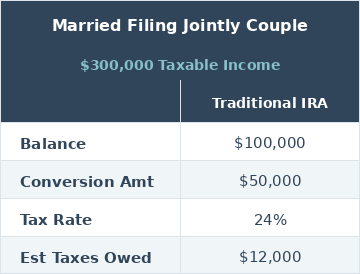
The objective here is to convert Traditional IRA funds (deductible contributions) to the Roth IRA. Because the contributions were originally tax deductible, all of the funds are taxable upon the conversion.
There is no limit to the conversion amount or frequency, but the IRS will have your tax bill waiting for you. The dollars converted are added onto your taxable income.
Caution is required here as this can push you into a higher tax bracket. Example below:
Assuming you are over the income limits to directly contribute to a Roth IRA, we have to go about getting funds into your Roth IRA via a Roth conversion but with non-deductible Traditional IRA contributions.
For example, you put $7,000 into your Traditional IRA and record it on your tax return as a non-deductible contribution for that tax year. You then convert the $7,000 to your Roth IRA while it is still in cash (not invested).
The $7,000 is now your basis. Because there was no growth on the $7,000, you generally have a $0 tax bill on this conversion.
What if you have a monthly auto deposit into your Traditional IRA and invest the funds throughout the year? Let’s assume the $7,000 basis (your total contributions) grows to $7,500 by the end of the year. Then you will pay taxes on the growth above your basis ($500) when you file your tax return.
Side note for spouses, as long as one spouse has income, both spouses can participate in maxing out their annual IRA contributions.
The most common is the “pro-rata rule.” Note how the first example clearly states, deductible contributions.
Let’s say you had $100,000 in your Traditional IRA (all deductible contributions) and decided to make a $7,000 non-deductible contribution and then immediately convert the $7,000. The IRS will now force you to use the “pro-rata” rule.
This calculates the total value of all of your non-Roth IRA’s (Traditional, SEP, and SIMPLE) and provides you with an additional taxable amount on the conversion. Extreme caution must be exercised here as not understanding the pro-rata rule is the most common and costly mistake.
A common problem is you have rollover IRA funds from previous employers in your Traditional IRA.
Let’s say you start with a new employer or you are a practice owner and launch a 401(k) for you and your employees. Most 401(k) plans allow for rollovers into a plan.
So, you could take your Traditional IRA funds and roll those into the new 401(k) plan (assuming they are all tax-deductible contributions). Assuming you have no other non-Roth IRA’s, you can now utilize the “Backdoor Roth” strategy without fear of violating the pro-rata rule.